In vacuum systems, leaks are quantified by their leak rate, typically measured in mbar*l/s (millibar liters per second). This unit represents the amount of gas that passes through a leak in a given time under a specific pressure differential.
A basic method involving immersing the pressurized component in a liquid and observing bubbles to identify leaks.
Applicability: Suitable for low-vacuum pressures up to 10^-4 mbar
Pump-Down Test
Involves evacuating a closed vessel to a certain pressure, then measuring the time taken for the pressure to return to its original level, indicating the presence of a leak.
Applicability: Effective for detecting leaks in various vacuum systems.
Pressure Rise Test
Plotting the vacuum level against time after achieving a vacuum, with a straight line indicating a leak.
Applicability: Suitable for identifying leaks and gas liberation from system walls.
Helium Sniffer Mode/Helium Vacuum Mode Tests
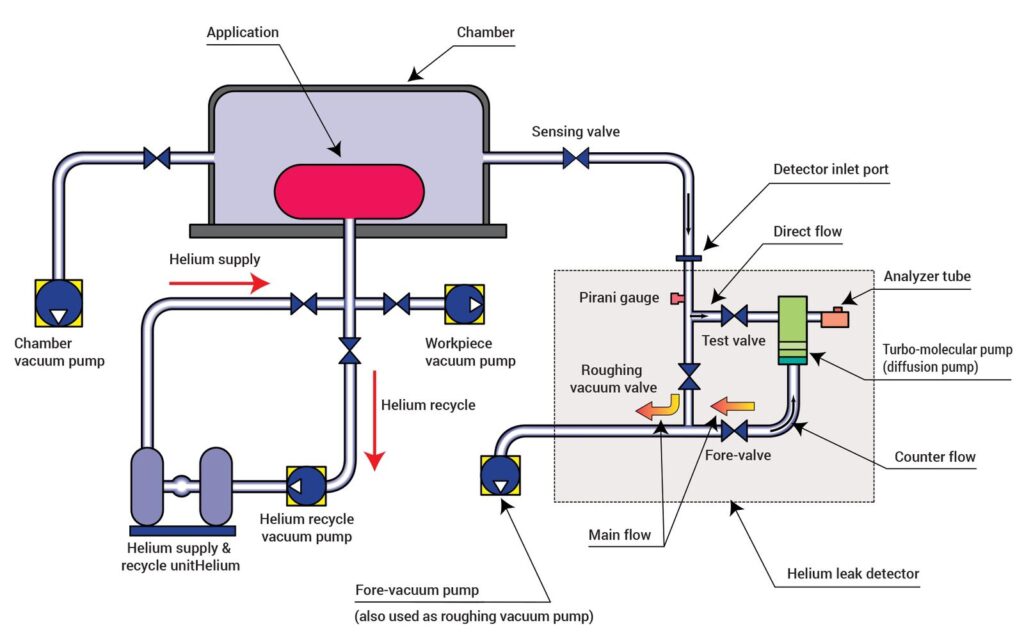
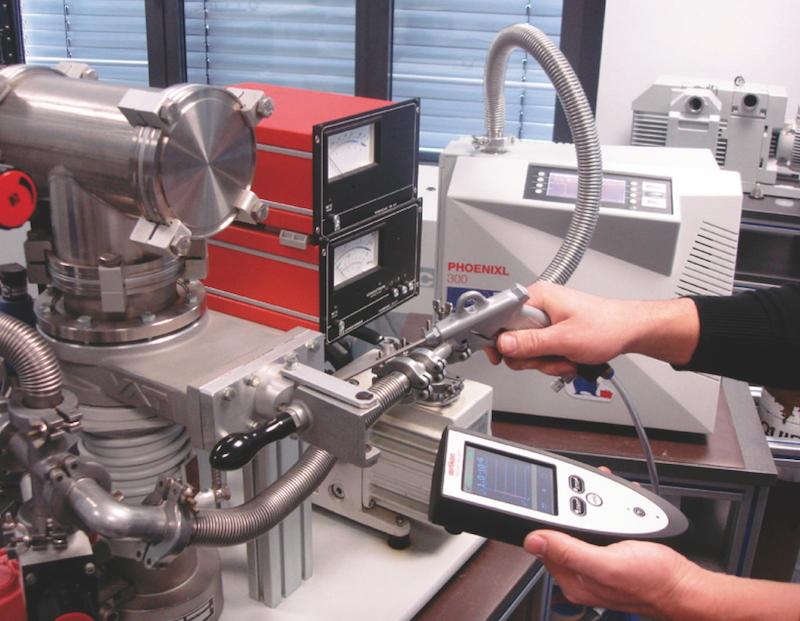
Utilizes helium as a tracer gas, detecting leaks with a mass spectrometer by analyzing gas collected from potential leak points.
Applicability: Effective for detecting leaks in various vacuum systems.
Vacuum Levels
Rough Vacuum Refers to the range of pressures typically between atmospheric pressure (760 Torr or 1013 mbar) and around 1 mbar. Rough vacuum systems are used in applications like vacuum filtration and freeze-drying.
High Vacuum Refers to the range of pressures below 10^-3 mbar (0.1 Pa). High vacuum systems are employed in processes such as electron microscopy and semiconductor manufacturing.
Ultra-High Vacuum (UHV) Refers to pressures below 10^-7 mbar (10^-9 Pa), characterized by extremely low gas densities. UHV systems are crucial in surface science research and materials analysis.
Importance of Expertise
Vacuum leak detection requires a high level of expertise due to several factors:
Precision Detecting small leaks demands precise instruments and techniques. Trained professionals can accurately interpret results and identify potential issues.
Safety In applications involving hazardous materials or high-pressure differentials, expertise is crucial to ensure the safety of personnel and equipment.
Efficiency Skilled technicians can optimize leak detection procedures, reducing downtime and minimizing the impact on production processes.
Knowledge of Equipment: Understanding the intricacies of vacuum systems and leak detection equipment is essential for effective troubleshooting and maintenance.
Measuring Vacuum Leak Rates
Leak rates quantify the amount of gas passing through a leak per unit time. It’s calculated using the formula: Leak Rate = Volume × (Measured Rise in Pressure) / Time Taken. Standards like DIN EN 1330-8 provide guidelines for helium leak rate criteria, essential for quality assurance.